CATEGORY
Visitor Experience
DATE

Why Many Exhibitions Fail?
Many exhibitions fail for a simple reason: they are designed around content — not around how people feel. For years, visitor experience in museums has been discussed primarily in terms of accessibility, interpretation, and engagement. Yet one of the most influential dimensions of an exhibition often remains invisible: how people feel as they move through it.
I really understood it when I was asked to write a publication: "best practices” guide for museums. Rather than relying solely on existing literature and professional experience, I decided to observe. Over several months, I visited museums of different scales and typologies across multiple countries, paying close attention not only to exhibitions themselves, but to the behaviour of visitors moving through them.
Despite all the differences between museums, patterns emerged quickly.
Most barriers to engagement were not physical. They were emotional and sensory. Noise. Density. Intensity. Information overload. Visitors were not disengaging because the content was weak or lacked value, but because nobody had designed the rhythm of their experience and how it should unfold.
Emotional engagement does not always manifest itself through excitement. Sometimes it looks like prolonged attention, reflection, or the willingness to remain with an uncomfortable idea longer than expected.
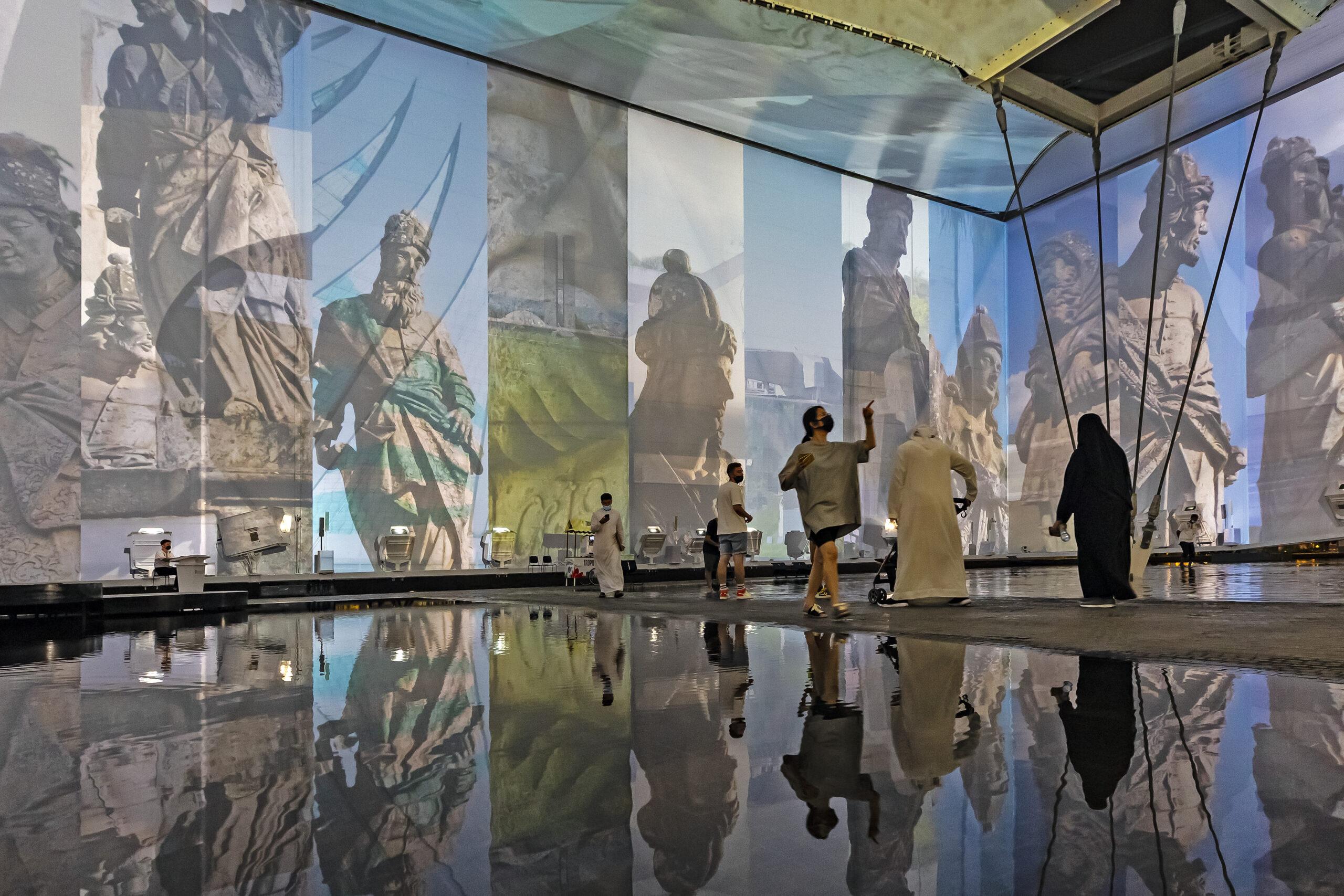
Image: courtesy of BeWunder
The best museums increasingly recognise that the visitor experience begins long before entering the exhibition and continues long after leaving it. Journey maps help identify key touchpoints, moments of friction, and opportunities for engagement across the entire museum ecosystem.
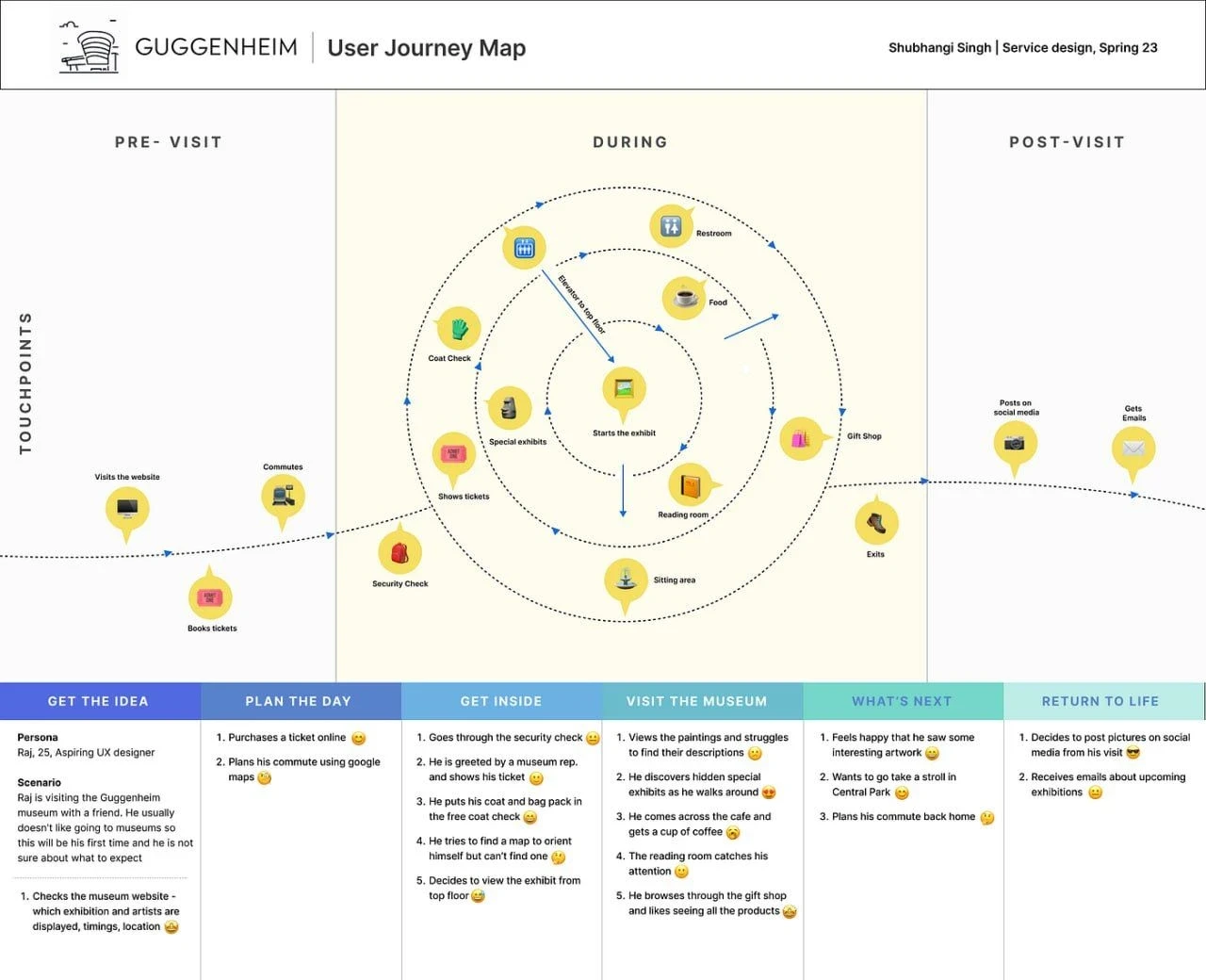
Image: Guggenheim User Journey Map
Content Is Not the Problem
A meaningful visitor experience is not primarily determined by the medium through which information is delivered — whether through labels, audio guides, multimedia installations, or interactive exhibits. It is determined by the sequence of emotional states visitors move through over time.
Not simply where they learn, but where they recover. Not only where they engage deeply, but where they are allowed to process what they have encountered.
The framework I kept returning to was deceptively simple:
Understanding → Release → Immersion → Pause.
Then repeat.
Most exhibitions build continuously toward a climax and then abruptly end. Visitors leave informed, perhaps, but often exhausted. Emotional intensity without modulation rarely creates memorable experiences. More often, it produces fatigue.
Rhythm matters.
Emotional Mapping as a Design Tool
While exploring this idea more formally, I encountered Robert Plutchik's Wheel of Emotions. The model itself is not without limitations, but it introduced an important possibility: experiences can be designed not only according to their intensity, but according to the quality of emotions they evoke.
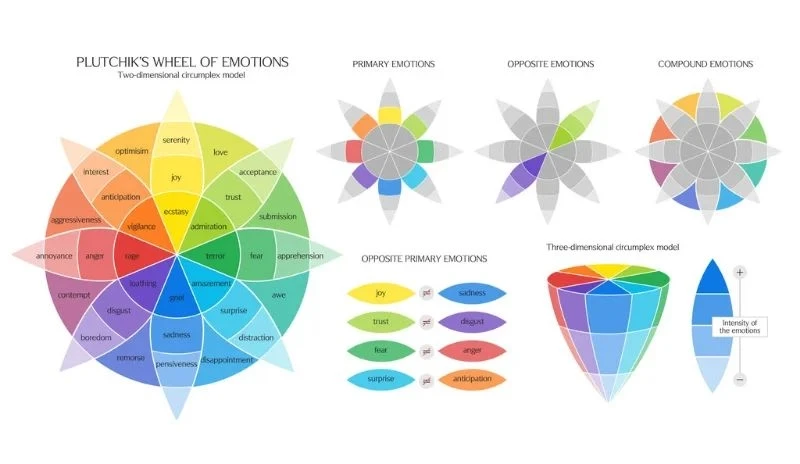
Image: Plutchik's Wheel of Emotions
Curiosity differs from anticipation. Tension differs from anxiety. Reflection differs from relief. These emotional states support different interpretive objectives and belong to different moments within a visitor journey. Treating them as interchangeable is one of the reasons exhibitions sometimes feel overwhelming, monotonous, or emotionally incoherent.
Designing visitor experiences therefore requires asking a different set of questions:
Where should uncertainty emerge?
Where should confidence be restored?
Where should visitors be challenged?
And where should they simply be allowed to breathe?
Making the Invisible Visible
Several years ago, I was working on a museum project where exhibition concepts repeatedly failed to gain approval. The ideas themselves were strong, yet something essential remained difficult to communicate.
The client could understand what visitors would see. They struggled to understand what visitors would experience.
In response, I introduced an emotional heat map as part of the visitor journey presentation. Instead of describing only content and spatial organisation, we visualised intensity, pacing, release, and transition points across the exhibition.
I also recognised that peak moments are important. Experiences of wonder create anchors in memory, helping visitors organise and retain what they encounter later.
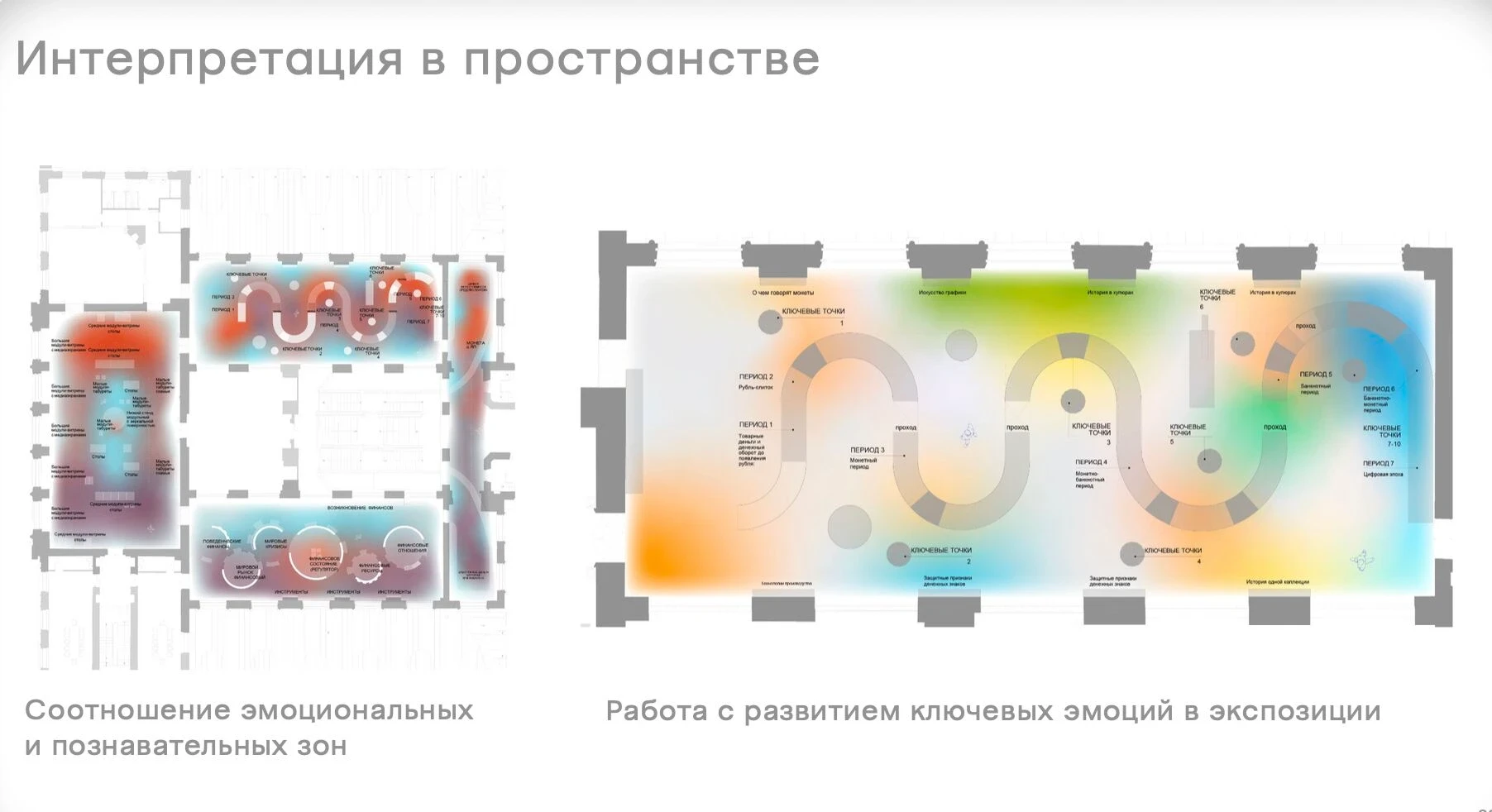
Image: Interpretation in Space.
Left: Relationship Between Emotional and Cognitive Zones. Right: Working with the Development of Key Emotions Throughout the Exhibition
The conversation changed immediately. Together, we reshaped the project into what the client described as a cinematic visitor journey — reconsidering sequencing, thresholds, and moments of reflection. It is important to remember as well that meaning is often constructed collectively. Visitors interpret, negotiate, and reinforce experiences through interaction with those around them.
The same concept that had previously been rejected was ultimately approved because its emotional logic had become visible.
What the Field Is Catching Up To
At the time, this approach felt intuitive rather than methodological.
Today, similar principles increasingly appear in institutional guidance and professional practice. Organisations such as the American Alliance of Museums discuss visitor wellbeing and emotional engagement more explicitly. Exhibition studios including Solid Light describe visitor journeys through frameworks that acknowledge pacing, emotional transition, and experiential coherence.
Different practitioners. Different contexts. Remarkably similar conclusions: exhibitions are not simply containers for information. They are sequences of experiences unfolding through time.
Some of the most compelling museum experiences of recent decades operate according to this principle. Increasingly, museums are beginning to approach exhibitions as emotional systems rather than sequences of objects. Visitor experience can be mapped, tested, and intentionally orchestrated through space.
The National Museum of African American History and Culture structures both physical movement and emotional progression through carefully choreographed descent and ascent. The Imperial War Museum North uses scale, light, silence, and confrontation to regulate emotional intensity throughout the visit. In these institutions, experience is not incidental. It is designed.
The diagram below illustrates how emotional intensity can be distributed across a gallery space. Rather than treating all exhibition areas equally, interpretive designers identify moments of tension, reflection, empathy, and release, deliberately shaping the visitor's psychological journey alongside the informational narrative.
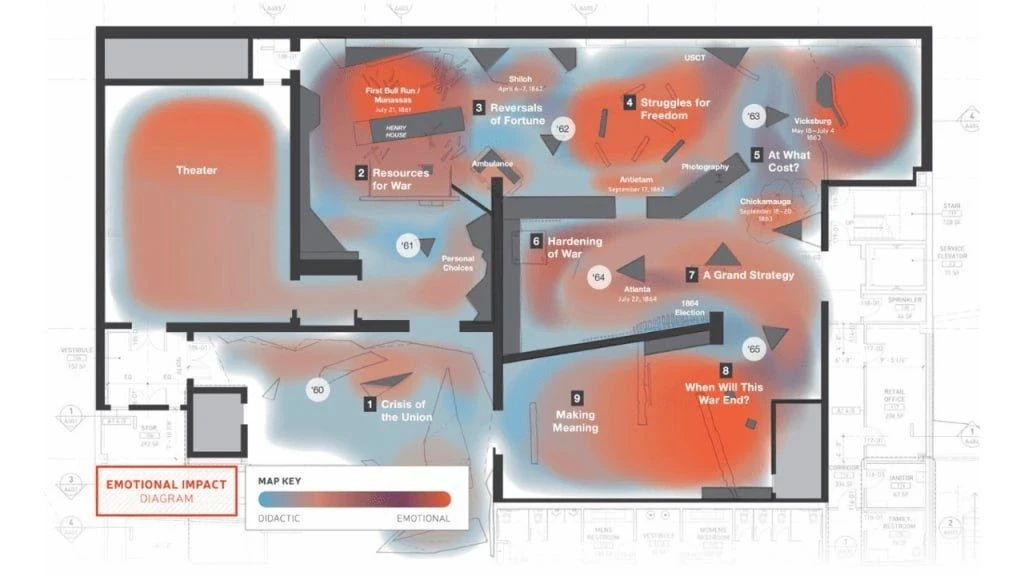
Image: Emotional Impact Diagram (American Civil War Museum)
The Real Shift
The most significant transformation currently taking place in museums is not technological. It is conceptual. Museums are moving — gradually, unevenly, but unmistakably — from designing primarily what visitors see toward designing what visitors feel, and in what sequence.
Objects remain essential. Research remains essential. Interpretation remains essential. But understanding how people emotionally navigate these elements has become equally important.
People rarely remember every fact they encounter in an exhibition. They remember moments of wonder. Moments of recognition. Moments of discomfort. Moments of connection. Those emotional traces shape what endures long after the visit itself has ended.
Don't design exhibitions. Design how people feel.
That is not a secondary consideration. It is the design brief.