YEAR
2021
CITY
MOSCOW
SERVICE
CONTENT DEVELOPMENT
THE BRIEF
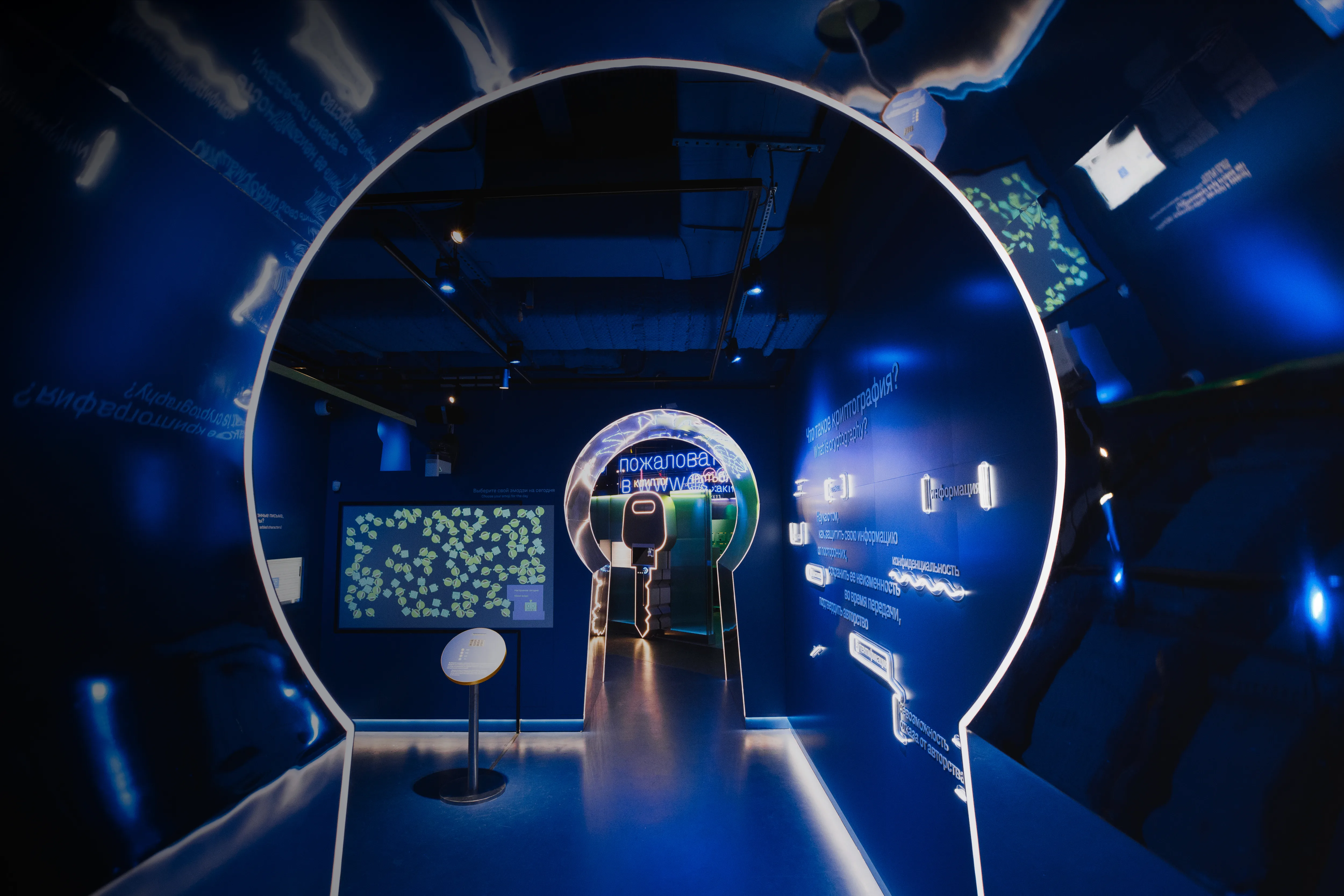
The Cryptography Museum was conceived as the first and only scientific and technological museum in Russia dedicated to cryptography, secret communication technologies, mathematics, and the systems shaping how information is hidden, transmitted, protected, and controlled.
The museum is located inside the historic building of the legendary Soviet “Marfino Sharashka” — also known as Research Institute No. 2 and “Object No. 8” — where Soviet scientists once developed encrypted communication systems for secure government telephone networks. The institution therefore required not only an exhibition design strategy, but a conceptual framework capable of connecting the historical atmosphere of secrecy and scientific research with contemporary digital culture, cybersecurity, blockchain technologies, and the future of information systems.
Pitch was commissioned to design and deliver the multimedia exhibition complex, develop audiovisual and interactive content, create bilingual interactive applications, and integrate multimedia technologies across the museum experience.
THE RESULT
The Cryptography Museum opened as the first and only public scientific museum in Russia dedicated entirely to cryptography, secret communication systems, and the technologies underlying the digital world.
Combining historic encryption devices, immersive storytelling, and more than 130 interactive and kinetic installations, the project established a new model for communicating highly abstract scientific subjects through spatial experience and multimedia interpretation. The museum includes 66 interactive applications and 53 audiovisual content pieces, creating an unusually dense and layered educational environment requiring approximately 16 hours to fully explore.
More importantly, the project demonstrated that subjects traditionally considered inaccessible — mathematics, encryption systems, cybersecurity, and algorithmic communication — can become emotionally engaging public experiences when approached through the right narrative and interpretive framework.
Located inside one of the most symbolically charged sites in the history of Soviet scientific secrecy, the museum transformed a former closed research environment into an open public institution dedicated to technological literacy, critical thinking, and the cultural understanding of information systems in the digital age.
THE CHALLENGE
Cryptography presents a fundamental museum paradox: it shapes modern civilisation everywhere while remaining almost entirely invisible to the public.
Most visitors interact daily with encrypted systems — messaging platforms, financial and banking operations, digital identity, state infrastructure, blockchain technologies — without understanding how any of them function. At the same time, the subject itself is highly abstract. Mathematics, algorithms, code systems, and invisible data exchange rarely produce intuitive emotional engagement inside exhibition spaces.
The challenge was therefore not simply educational, but interpretive: how do you make invisible systems of secrecy, communication, and information control spatially understandable without oversimplifying the science behind them?
The project also had to bridge radically different historical and technological layers simultaneously. Soviet cryptographic machines, Cold War secrecy, mechanical encryption devices, contemporary cybersecurity, blockchain systems, NFT technologies, and speculative digital futures all needed to coexist within one coherent visitor experience. The museum required a narrative architecture capable of connecting classified technological history with the everyday digital systems now shaping contemporary life.
An additional layer of complexity came from the building itself. The museum occupies a historically charged site associated with secret Soviet scientific development, requiring the exhibition to carefully balance immersive contemporary media environments with the authenticity and atmosphere of the original architectural context.
THE APPROACH
The conceptual move was to treat cryptography not as a narrow technical discipline, but as an invisible infrastructure shaping modern civilisation.
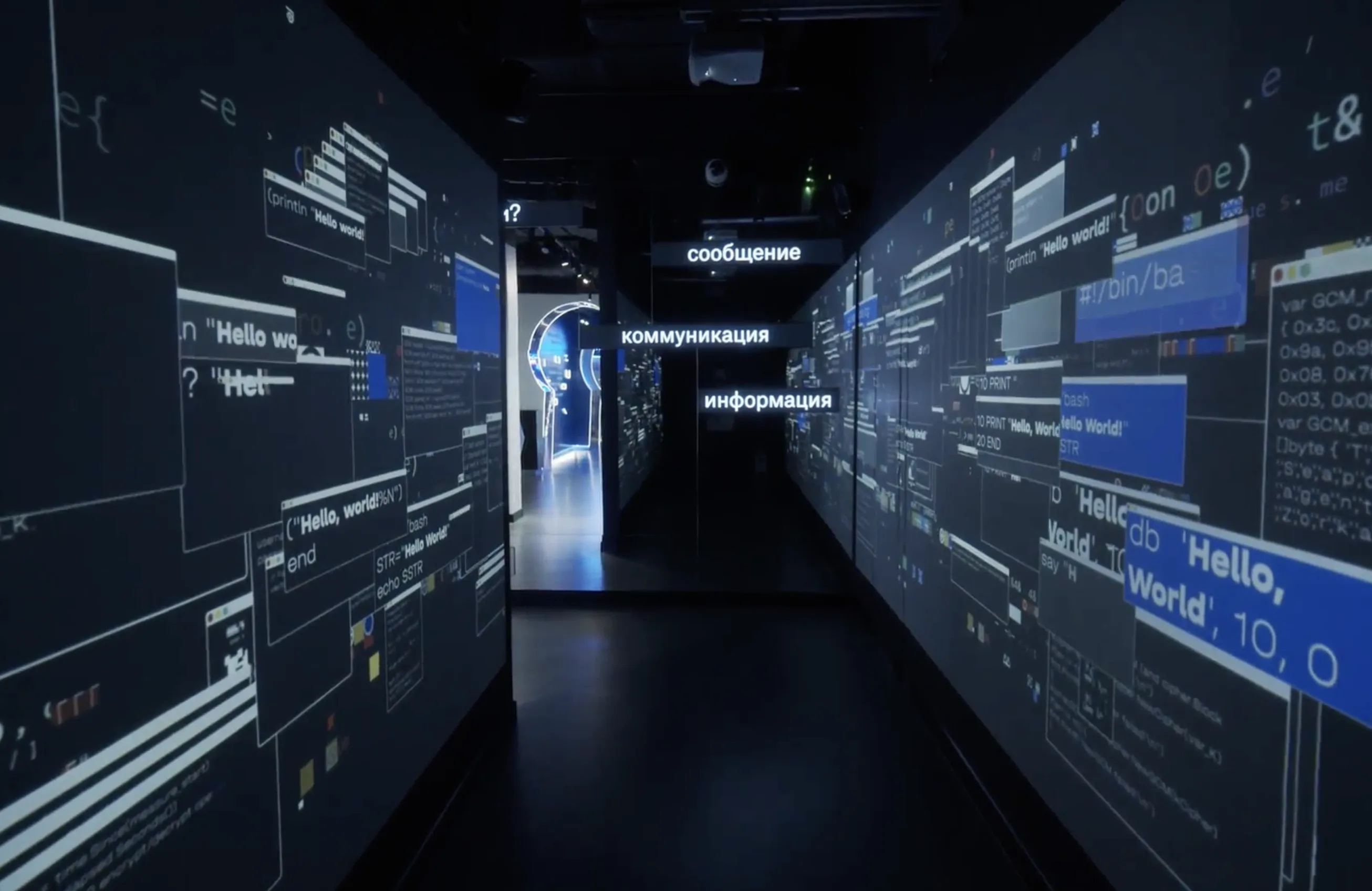
Rather than organising the museum around isolated historical artifacts or technical explanations, the exhibition was designed as a journey through the evolving relationship between secrecy, technology, power, and human communication. Narrative architecture connects the historical origins of encryption systems with contemporary digital realities — showing visitors how cryptography moved from military and state-controlled environments into everyday life through smartphones, online banking, blockchain technologies, and digital identity systems.
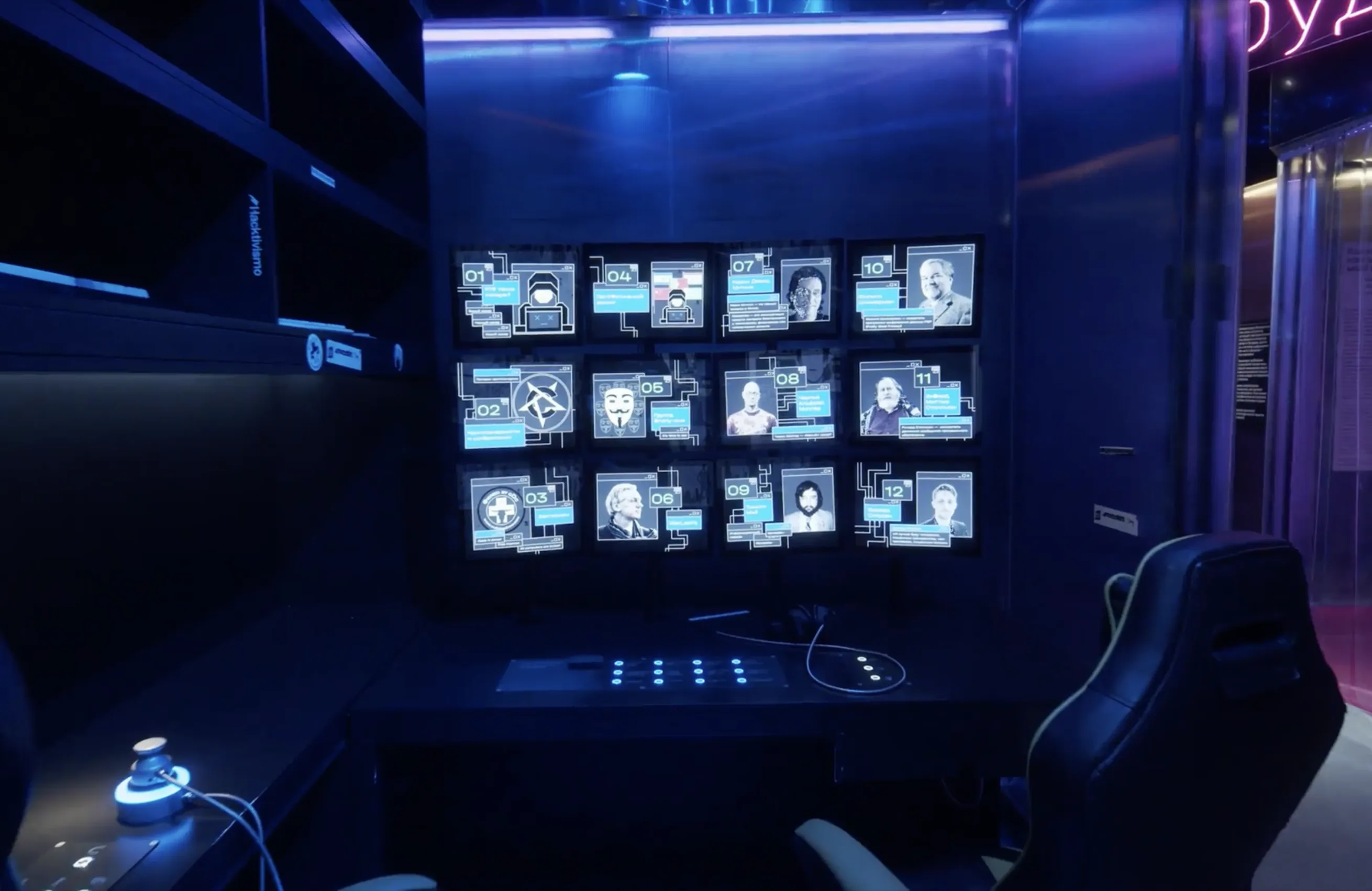
The visitor experience was structured across three interconnected temporal layers: the history of cryptography, the technologies of the present, and speculative future systems of communication and information control. Historic encryption devices, archival materials, and classified technologies are combined with interactive environments, kinetic installations, game mechanics, VR experiences, AR applications, and multimedia storytelling designed to make abstract systems physically and emotionally legible.
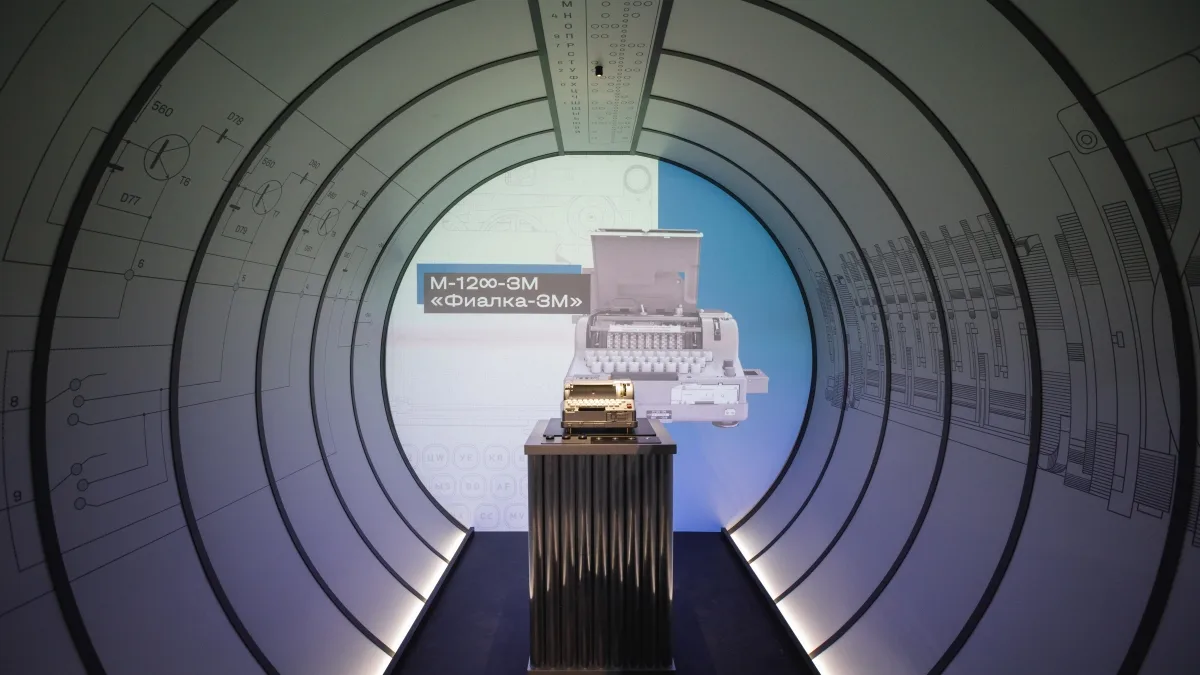
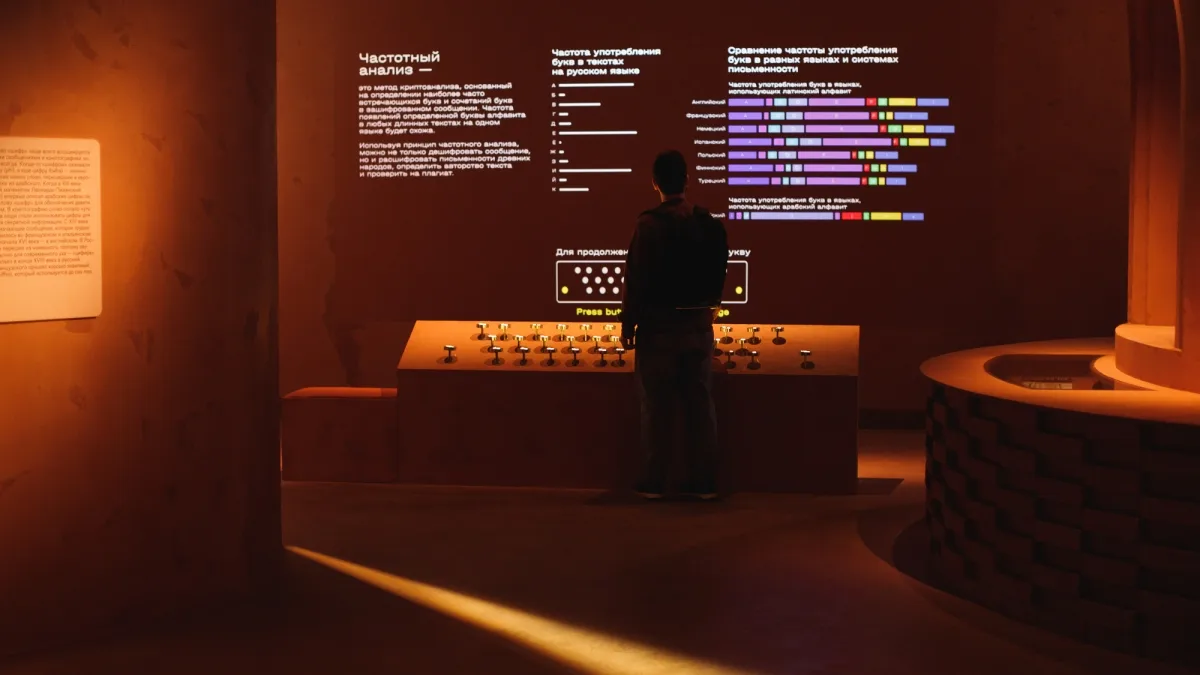
Interactive installations became a central interpretive tool throughout the museum. One of the key exhibits focuses on the legendary Soviet encryption machine “Fialka” (M-125), whose existence remained classified until the early 21st century. Other installations translate contemporary technologies into participatory experiences: visitors can generate NFT tokens from their own images through blockchain-based interaction systems, experiment with password security through arcade-inspired game mechanics, or enter speculative future environments using VR technologies.
A major design principle was making complexity accessible without simplifying the underlying science. More than 130 interactive and kinetic installations, educational game-based exhibits, and multimedia systems were designed to engage multiple audience levels simultaneously — from children and families to engineers, researchers, and technology professionals.
Interface design and interaction logic formed part of the museum’s overall narrative system. Multimedia applications were developed in Russian and English, including accessibility adaptations and sign-language dubbing, ensuring that highly technical material remained publicly accessible across different audiences and modes of engagement.
The result is a museum where cryptography stops being an invisible background process and becomes a cultural, political, and human story about trust, secrecy, communication, and power in the digital age.

MY ROLES
I served as Creative Director, Head Researcher, Head of the Scriptwriting Team, and Creative Producer for the multimedia exhibition complex, leading the project from conceptual development through implementation.
My role focused on translating highly abstract scientific and technological material into a coherent spatial storytelling system capable of engaging broad public audiences without sacrificing intellectual depth or scientific rigor. I developed the narrative architecture and interpretive framework connecting historical cryptographic technologies, contemporary digital systems, and speculative future scenarios into one integrated visitor journey.
I directed the research process, led the scriptwriting team, and supervised the creation of audiovisual, interactive, educational, and game-based content across the museum’s multimedia environments. In close collaboration with museum specialists and experts from Kryptonite — one of Russia’s leading cryptographic technology companies — we developed interpretive systems capable of making invisible technological processes emotionally and intellectually accessible.
I also oversaw the integration of multimedia installations, interaction design, accessibility systems, and spatial media environments, ensuring conceptual consistency across narrative, technology, and architecture.