YEAR
2019
CITY
MOSCOW
SERVICE
EXHIBITION DESIGN
THE BRIEF
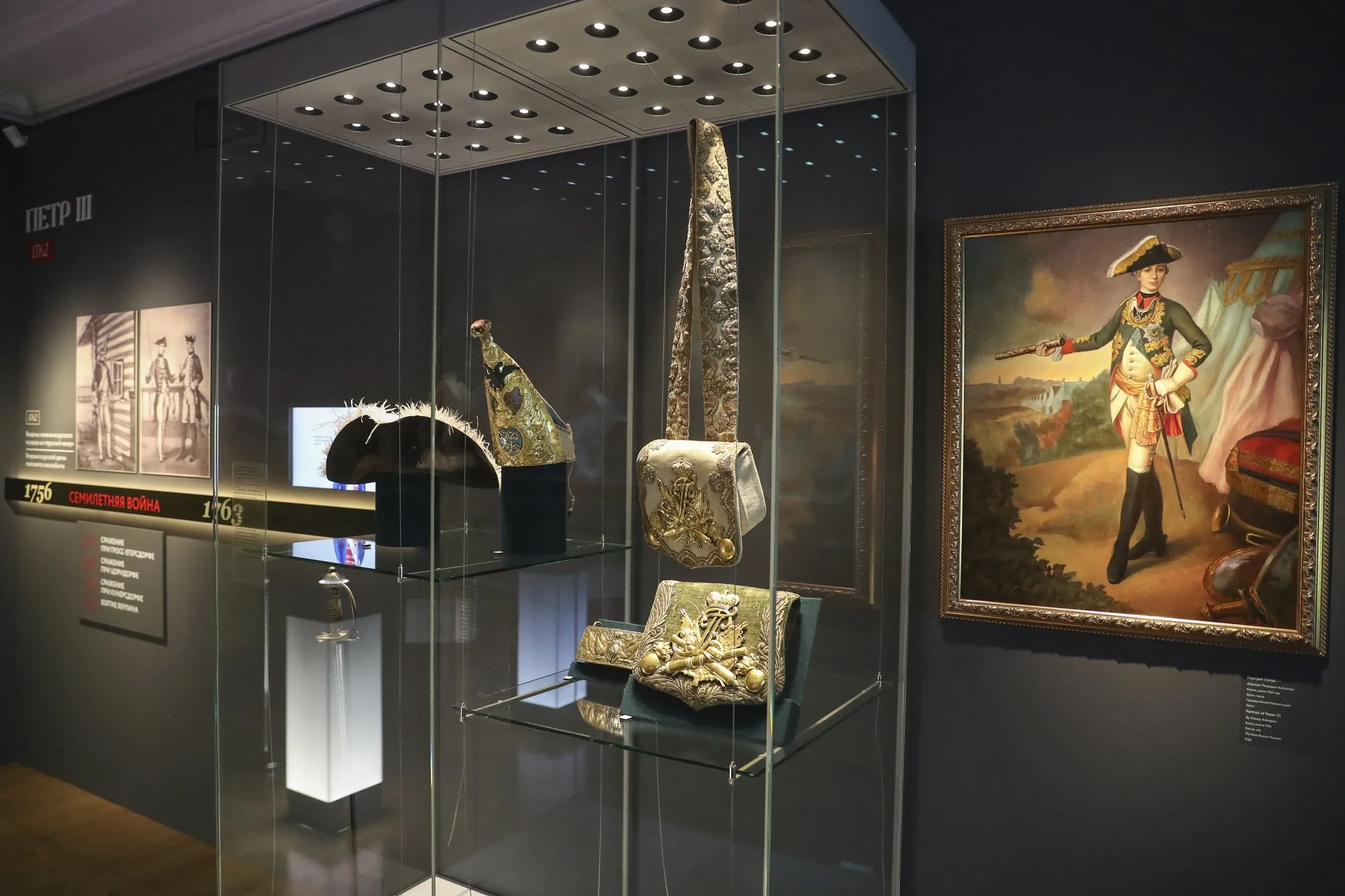
The Museum of Military Uniforms was conceived as a large-scale historical museum exploring how military dress shaped the visual language of statehood, hierarchy, power, and collective identity across Russian history.
Located inside the restored Cherkassky princess (later Turgenev-Botkin) estate in Moscow — a listed 18th-century architectural monument — the institution required more than a traditional military exhibition. The project needed a conceptual and narrative framework capable of transforming uniforms, artifacts, and ceremonial objects into a broader cultural story about how nations represent authority, ideology, discipline, and historical transformation through visual systems.
Rather than treating military uniform as costume or historical decoration, the museum approaches it as a form of social and political technology — a visible interface between the individual, the institution, and the state.
Pitch was commissioned to develop the museum concept, curatorial framework, multimedia exhibition system, audiovisual content, interactive environments, navigation, and visual communication strategy across 16 exhibition halls and 86 multimedia installations.
MY ROLE
I led the project as Concept Author, Co-curator, Creative Director and Lead of research and scriptwriting team, overseeing the development of the museum from the earliest conceptual stages through implementation.
My role focused on developing the curatorial and narrative framework that transformed the collection into a coherent spatial storytelling system distributed across 16 exhibition halls. I directed the research process, developed the interpretive structure, and wrote the narrative scripts connecting military artifacts, historical events, and broader cultural themes into one continuous visitor journey.
I also supervised the development of multimedia installations, audiovisual environments, interactive systems, and immersive storytelling elements, ensuring conceptual consistency between narrative, technology, scenography, and the historic architectural setting.
In close collaboration with architects, historians, designers, and multimedia teams, we developed an integrated exhibition language capable of balancing scientific accuracy, emotional engagement, and respect for the heritage environment.
THE CHALLENGE
Military uniform is one of the most symbolically charged artifacts in museum culture. It simultaneously represents state power, ideology, identity, technological development, and individual human experience. Yet without interpretation, even historically significant objects risk becoming static displays disconnected from contemporary audiences.
The challenge was therefore not simply historical, but cultural and interpretive: how do you transform military dress into a broader narrative about how societies construct power visually? How do you make visitors understand that uniforms are not merely clothing, but systems of representation designed to communicate status, order, belonging, fear, aspiration, and control?
The project also demanded a delicate balance between historical authenticity and contemporary experience design. The museum occupies a restored 18th-century heritage estate, requiring immersive multimedia environments and digital interpretation to be integrated without compromising the integrity and atmosphere of the architecture itself.
At the same time, the exhibition had to operate simultaneously across multiple visitor perspectives — from historians and military specialists to families and younger audiences encountering the subject emotionally rather than academically. The interpretive framework therefore needed to combine scientific rigor, emotional immersion, and accessible storytelling without reducing historical complexity

THE APPROACH
The conceptual move was to treat military uniform not as costume, but as a visual operating system of the state. Rather than presenting uniforms as isolated historical artifacts, the exhibition was structured as a narrative about how power becomes visible through ritual, hierarchy, aesthetics, discipline, and technological transformation. Each historical period reveals changing relationships between the individual and the state — expressed through silhouette, material, ornament, weaponry, ceremony, and bodily representation.
Narrative architecture was designed around the idea that military uniform operates simultaneously at several levels: practical technology, political symbol, social code, and psychological instrument. Historic garments, weapons, archival materials, scenography, projections, interactive environments, and immersive audiovisual systems were therefore integrated into one interpretive framework revealing how military identity is constructed and performed across time.
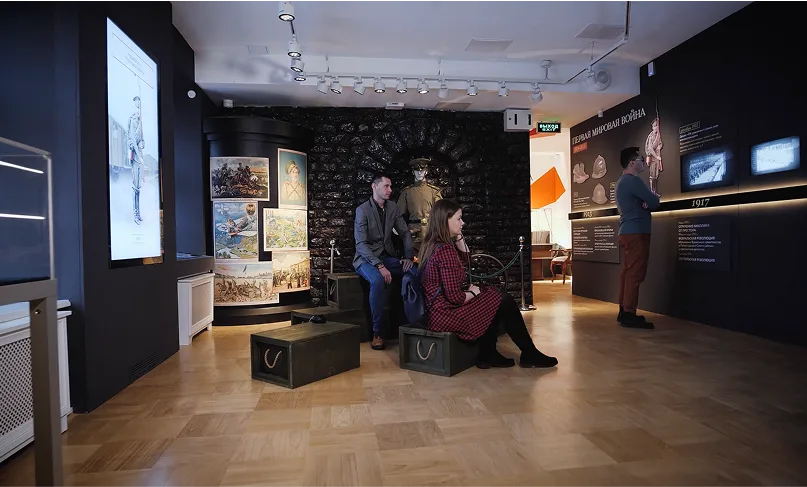
The visitor journey unfolds across 16 halls organised within the enfilade structure of the historic estate. Rather than neutralising the architecture, the exhibition uses the sequential rhythm and ceremonial character of the building itself as part of the storytelling system — creating transitions between eras through atmosphere, media, light, sound, and spatial compression.
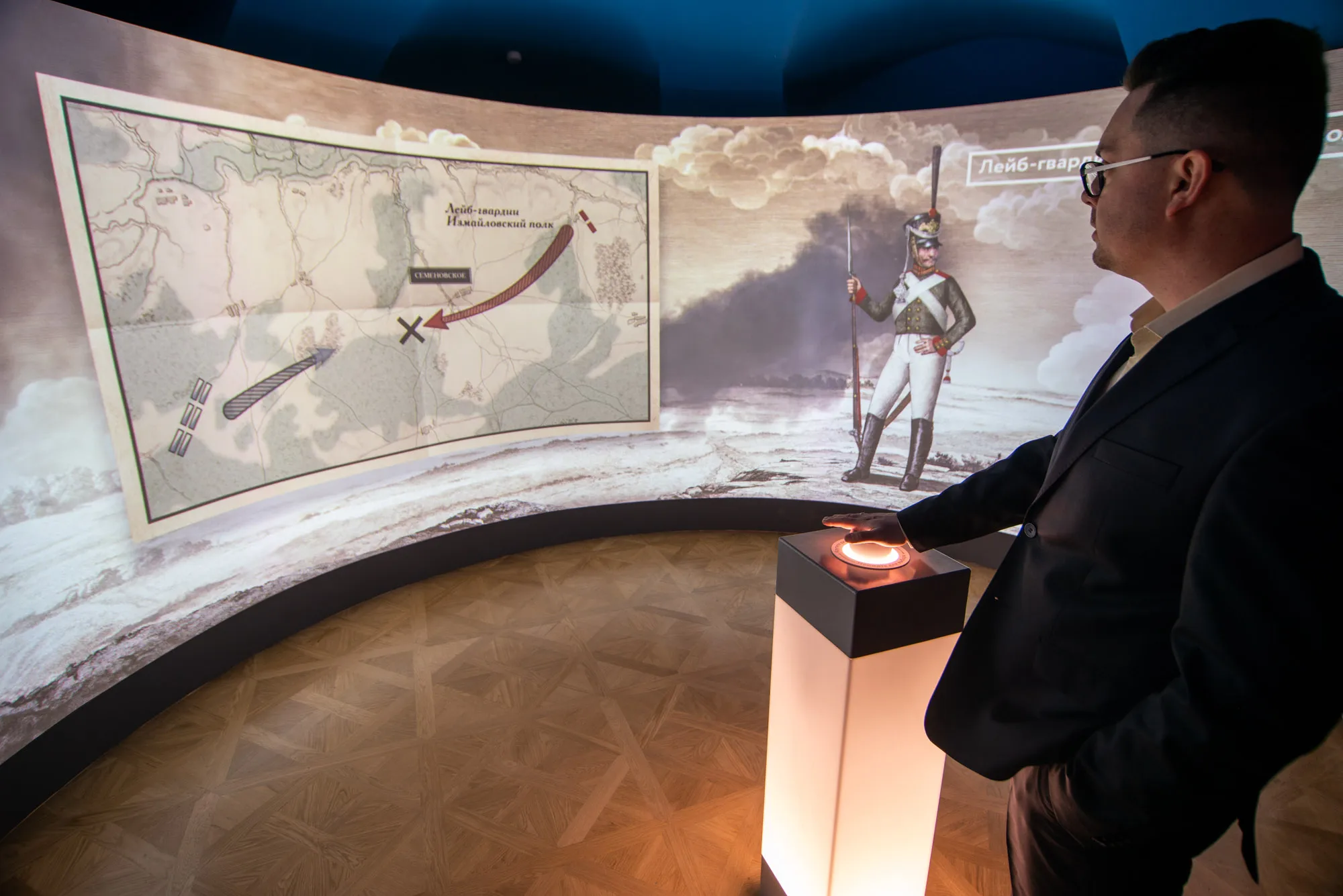
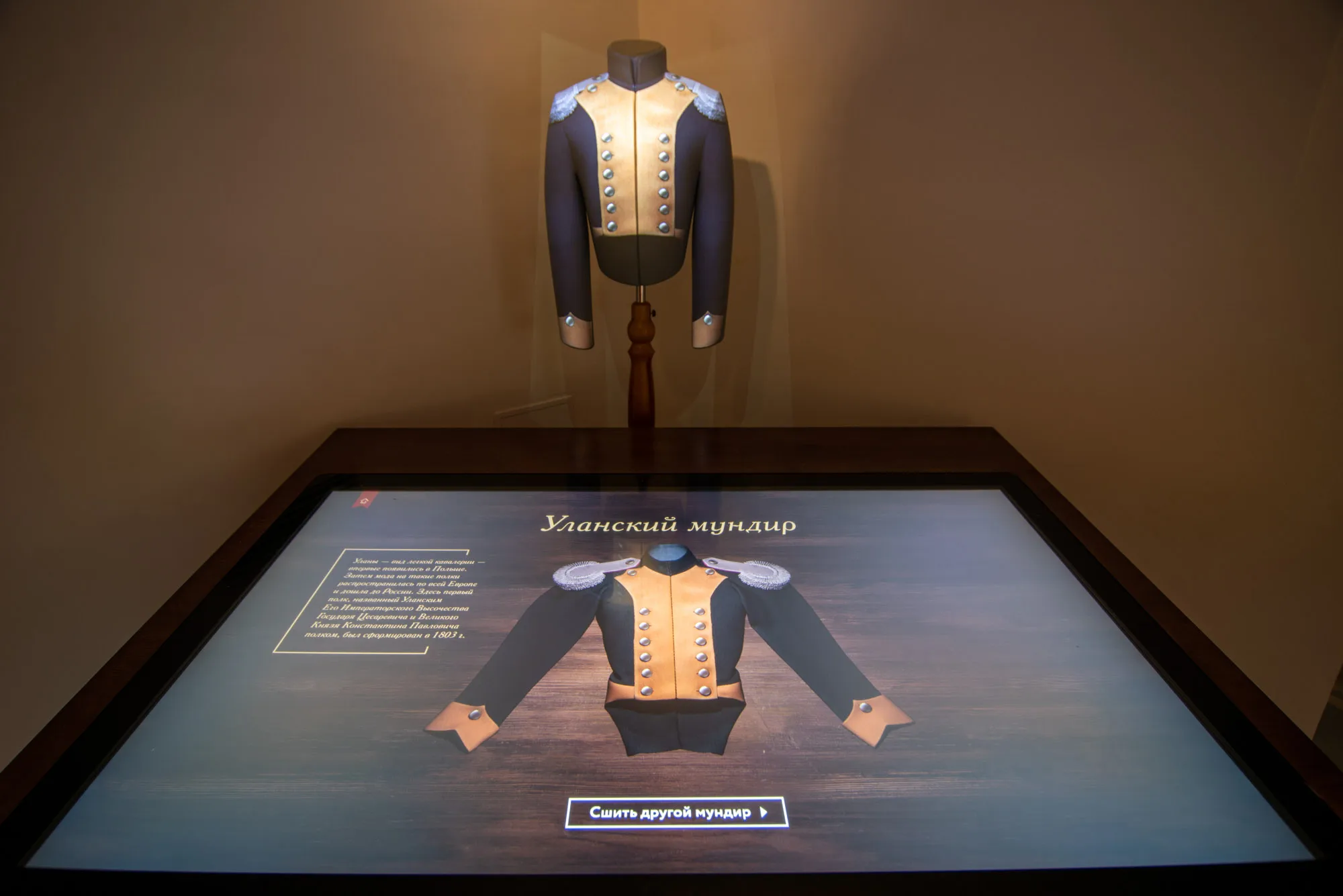
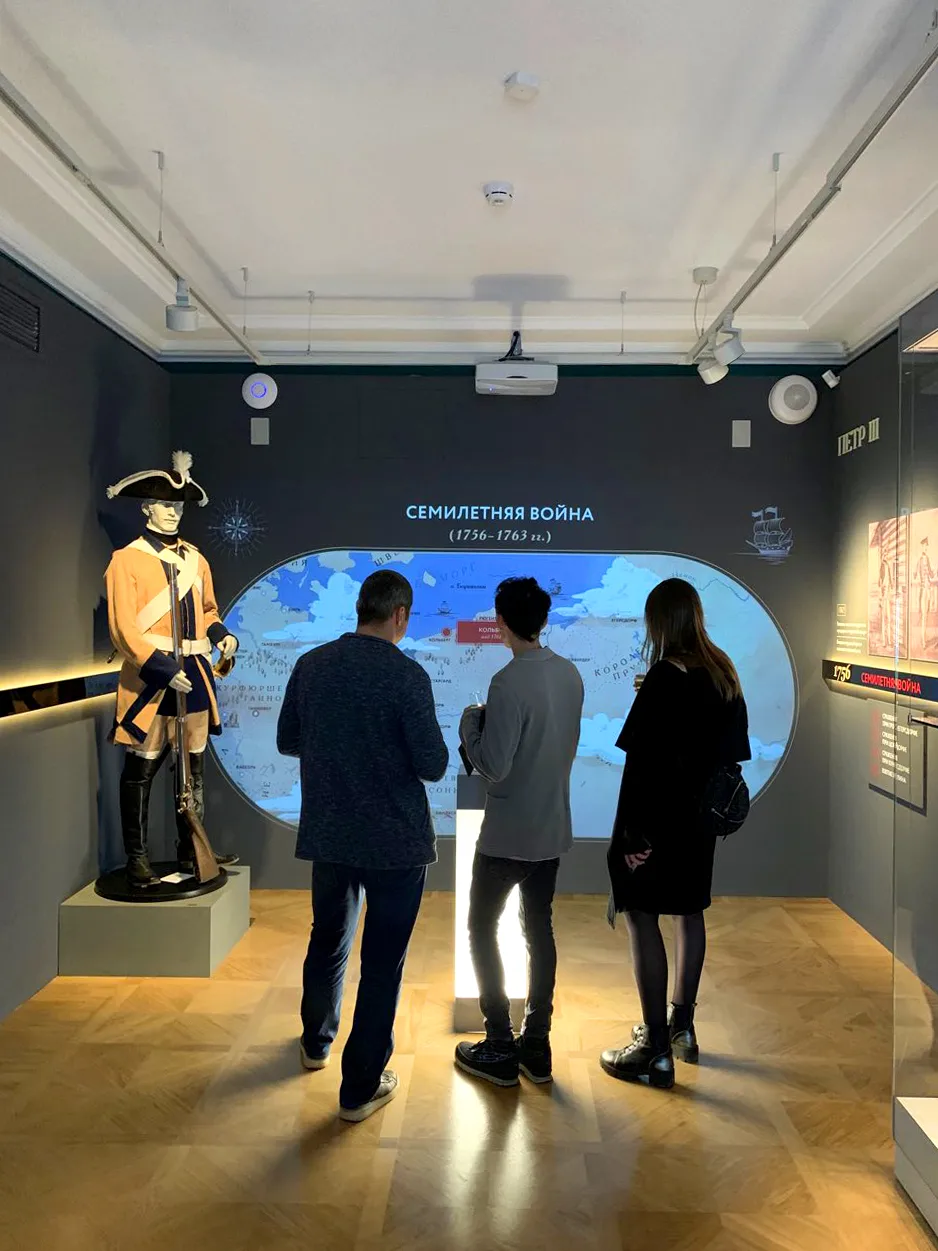
Multimedia installations became key interpretive instruments throughout the museum. Interactive battle reconstructions, holographic environments, projection systems, VR and AR experiences, animated archival materials, and game-based educational mechanics were developed not simply to illustrate military history, but to reveal the emotional, political, and cultural mechanisms embedded inside systems of representation and authority.
A major curatorial priority was ensuring that digital technologies amplified the psychological and symbolic dimensions of the collection rather than functioning as spectacle layered over heritage interiors. Multimedia systems were integrated carefully into the historic architecture, allowing contemporary media to deepen the interpretive power of the environment itself.
The result is a museum where military uniform becomes a lens through which visitors can understand broader questions of identity, power, ritual, discipline, collective memory, and the visual construction of the state.
THE RESULT
Opened in Moscow in 2017, the Museum of Military Uniforms became one of Russia’s most technologically advanced historical museums, combining heritage architecture, immersive storytelling, and multimedia interpretation across 16 exhibition halls inside a restored 18th-century estate.
The project integrated 86 multimedia installations, including projections, holographic environments, VR and AR experiences, interactive battle reconstructions, educational game mechanics, and a complete visual identity and navigation system. Rather than functioning as supplementary media, these systems became part of a unified narrative architecture connecting historical artifacts with contemporary public audiences.
The museum received significant professional recognition, including the Golden Trezzini Award for Best Museum Project, and established a benchmark for integrating immersive multimedia storytelling into sensitive heritage environments without compromising architectural authenticity.
More importantly, the project demonstrated how military history can be translated from static display into emotionally resonant cultural experience — transforming uniforms from historical objects into carriers of memory, identity, and historical imagination.