YEAR
2020
CITY
MOSCOW
SERVICE
SPATIAL STORYTELLING
THE BRIEF
The City of Moscow commissioned a permanent museum dedicated to the systems that keep a modern metropolis functioning: infrastructure, utilities, housing, transport, public services, and urban operations normally invisible to citizens.
The ambition was not simply educational. The museum was conceived as a public interface to the city itself — a place where visitors could understand how one of Europe’s largest urban systems actually works, and how thousands of interconnected processes shape everyday life.
The project occupied a restored listed building, requiring the museum concept and visitor experience strategy to emerge in parallel with a highly detailed architectural conservation process.
MY ROLES
I led the project as Creative Director, Curator, and Head of Research, defining the museum’s conceptual framework, visitor experience strategy, and narrative architecture from the earliest stages of development.
My role focused on translating complex urban systems into a coherent spatial storytelling structure that could operate simultaneously as public education, civic interface, and immersive cultural experience. I developed the phygital methodology integrating real-time city data into the exhibition narrative — defining how live operational information could function as meaningful interpretive content rather than technological decoration.
I personally defined the conceptual logic of the thematic zones, the visitor journey structure, and the interpretive framework connecting infrastructure systems to everyday human experience. I also led the scriptwriting team and supervised the development of multimedia, audiovisual, interactive, and game-based content across the exhibition, ensuring conceptual consistency between narrative, technology, and spatial design.
Multimedia installations, technical integration, and implementation were delivered by Pitch and Sila Sveta teams working within this curatorial and experiential framework.
THE CHALLENGE
Urban infrastructure is not a natural subject for a museum. It has no heroes, no conventional narrative arc, and no obvious emotional entry point. Moscow generates vast amounts of real-time operational data about its own functioning, but data alone produces comprehension, not engagement.
The deeper challenge was one of perspective. Citizens experience the city as residents, commuters, tenants, and pedestrians — not as system operators. The museum needed to bridge that gap without overwhelming visitors with technical complexity or reducing the subject to simplified infographics and interactive spectacle.
The problem was conceptual before it was spatial: how do you make invisible systems emotionally legible? How do you turn utilities, logistics, housing, transport, and municipal governance into a coherent visitor experience capable of engaging both a child and an urban planner?
The project also had to be integrated into a listed architectural building undergoing a meticulous historical restoration in parallel with the museum development, creating an additional tension between contemporary media systems and heritage constraints.

THE APPROACH
The conceptual move was to treat the city itself as the exhibit — not as a static representation of Moscow, but as a living operational organism the museum could make visible in real time.
Rather than presenting infrastructure as detached technical knowledge, the exhibition was designed to let visitors experience the logic of the city from the inside: to understand how systemic decisions shape everyday life, and how individual behaviour feeds back into larger urban processes. The museum operates as a phygital environment where physical installations, real-time city data, multimedia systems, and spatial storytelling function as a single narrative structure.
The visitor experience was organised as a gradual shift in scale across three interconnected thematic environments: “Management”, “Apartment”, and “City”.
The journey begins with a macro-level operational overview — a massive interactive LED “Dispatch Centre” visualising the real-time functioning of Moscow’s urban systems. Positioned at the entrance, the installation acts as a city-scale interface, allowing visitors to immediately grasp the volume, simultaneity, and interdependence of the processes required to operate a metropolis of more than 12 million people. Live indicators ranging from electricity consumption to water quality and environmental metrics transform invisible infrastructure into an immersive public-facing system.
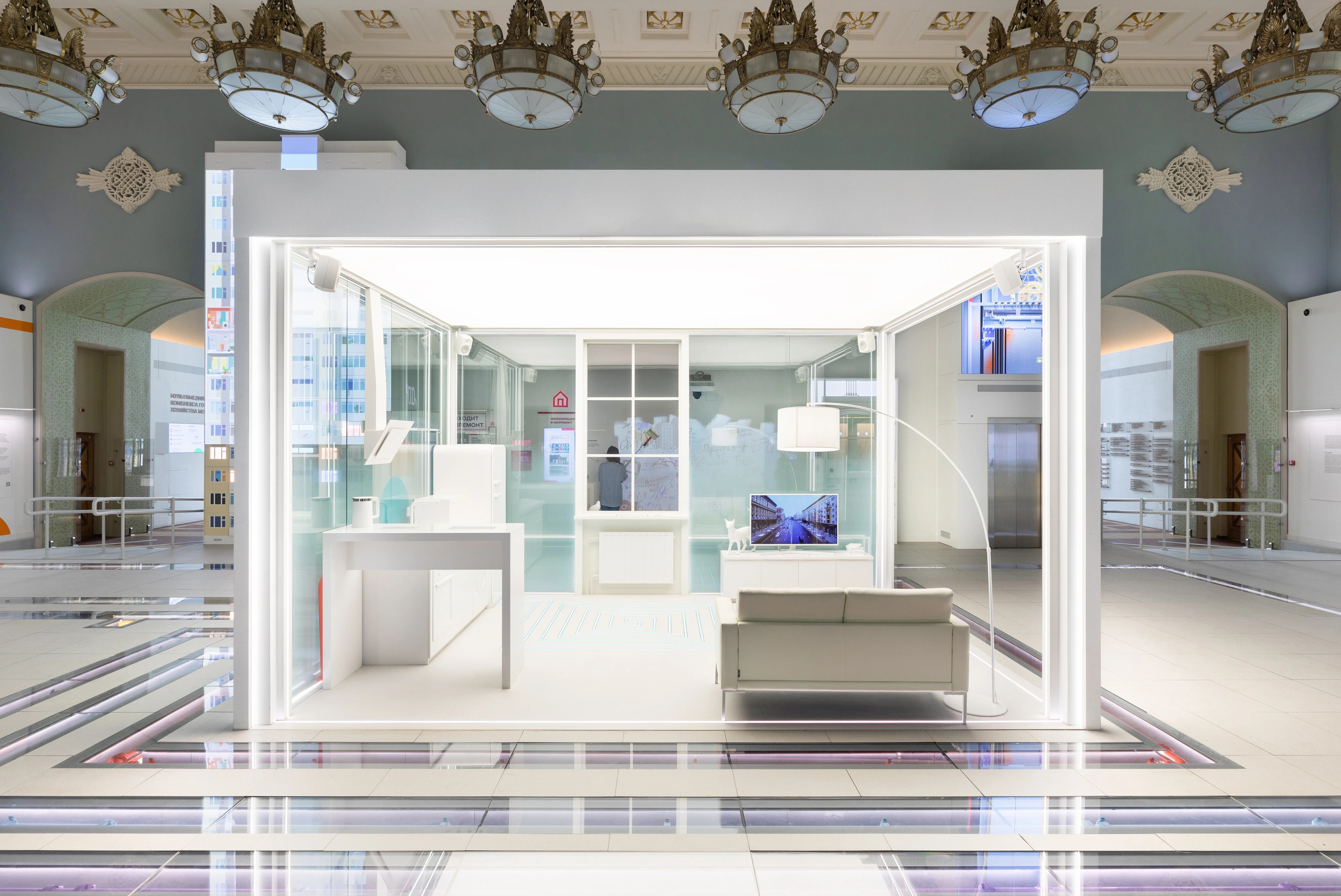
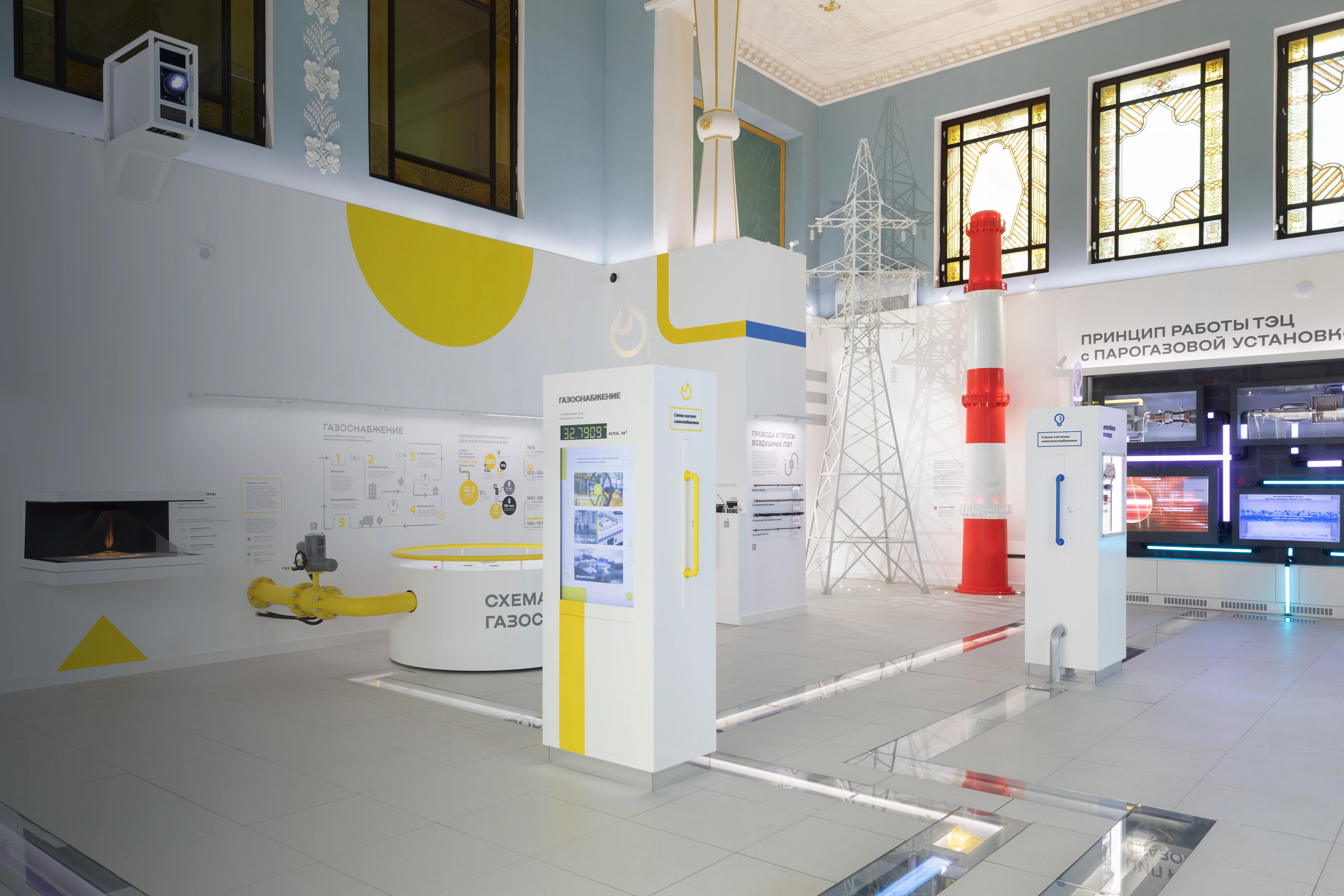
From there, visitors move into the “Apartment” zone — the human-scale core of the exhibition. At the centre of the hall sits a full-scale mock-up of a Moscow apartment, physically connected to the infrastructure networks sustaining it. Gas, water, heating, electricity, and utility systems are exposed through architectural cutaways, underground channels, and visible communications embedded into the floor itself. Rather than explaining infrastructure abstractly, the exhibition traces how resources physically arrive into everyday domestic life and where they originate within the wider urban system.
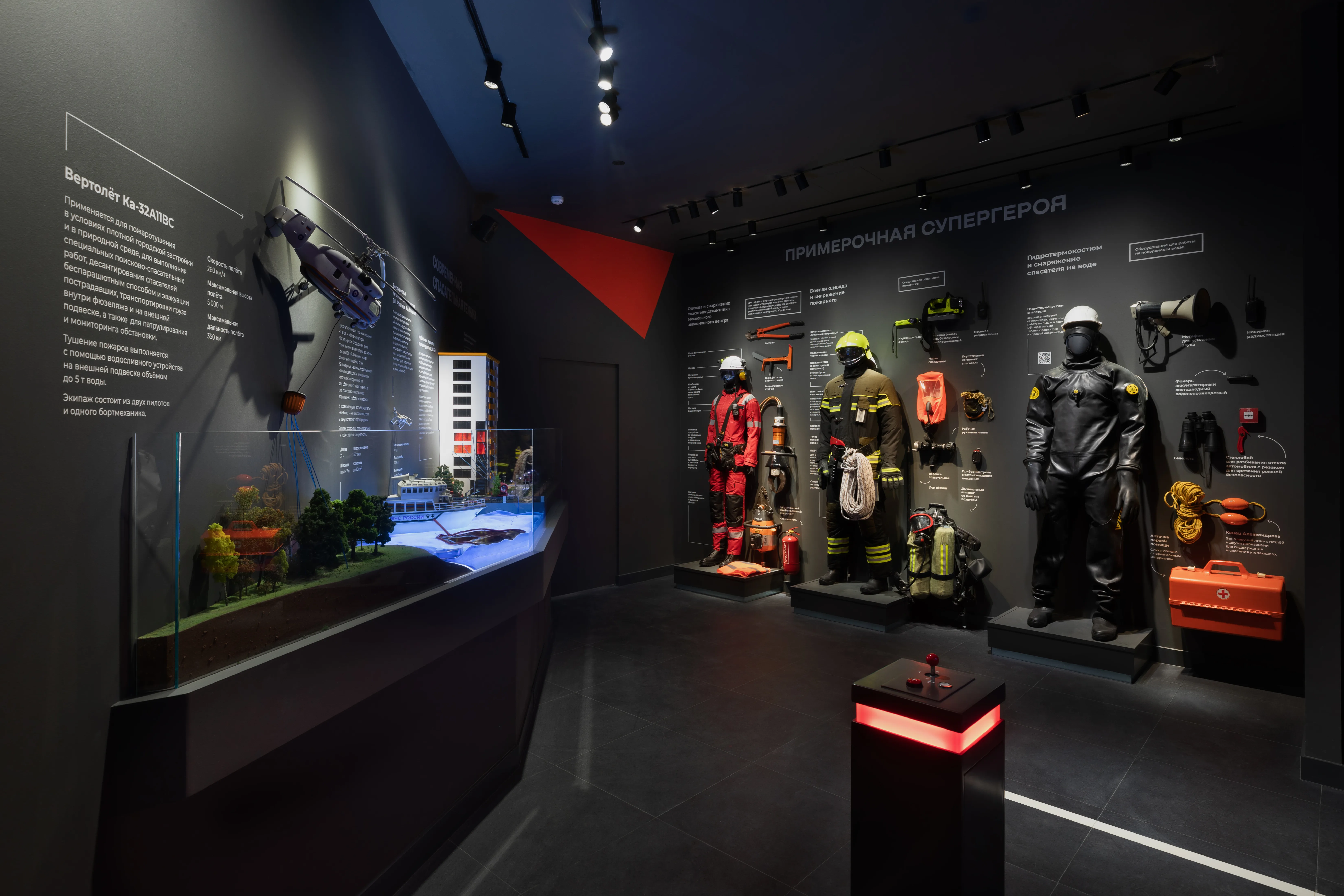
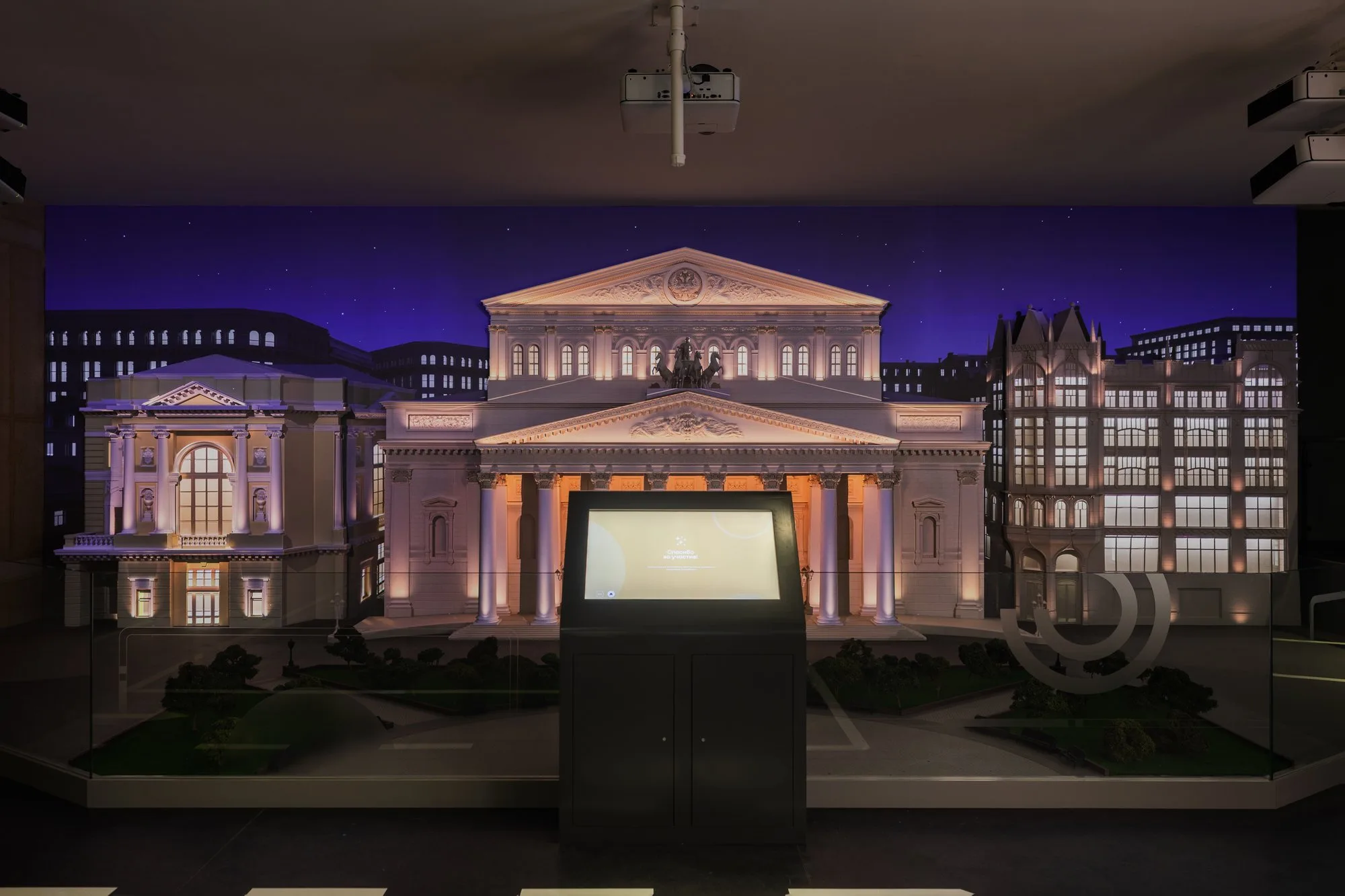
The final section expands outward again into the metropolitan scale of the city itself. Organised across two levels, the “City” zone explores how Moscow operates as a complex interconnected organism through large-scale multimedia environments, kinetic installations, immersive simulations, AR and VR systems, and interactive urban planning experiences. Visitors can step inside utility vehicle simulators, interact with robotic installations, experiment with public-space design, and navigate a monumental 50 m² city model enhanced through augmented reality interfaces and VR binocular systems.
Across all zones, interface design became part of the museum’s narrative architecture. A unified visual language connected navigation, environmental graphics, installation interfaces, and interpretive systems into a coherent design framework. Colour-coded thematic logic helped visitors intuitively navigate between infrastructure systems while reinforcing the museum’s systems-thinking approach at every level of the experience.
The result was not simply an exhibition about urban infrastructure, but a museum designed to make the operational anatomy of the metropolis emotionally and intellectually legible to the public.

THE RESULT
The Museum of Urban Economy opened in Moscow as one of Europe’s first large-scale phygital municipal museums — a permanent cultural institution where the city’s live operational systems form part of the exhibition itself.
Combining interactive environments, real-time data integration, immersive installations, and spatial storytelling, the project established a new benchmark for how urban infrastructure and civic systems can be translated into public experience. By spring 2026, the museum had attracted nearly 820,000 visitors, including more than 241,000 visitors in 2025 alone — an exceptional result for a museum with approximately 1,300 m² of exhibition space dedicated to a highly technical subject traditionally considered difficult for broad public engagement.
The museum quickly evolved beyond exhibition format into an active educational and civic platform. Over four years it hosted more than 12,000 guided tours, significantly expanded its educational programming, and welcomed visitors from dozens countries alongside numerous international delegations. Interactive educational initiatives, public quests, and school engineering programmes extended the project beyond the physical exhibition into a broader public engagement ecosystem.
The project received multiple national museum and exhibition awards, including first prize for “Opening of the Year” and “Best Educational Project”, alongside recognition for accessibility, multimedia integration, and digital public engagement. More importantly, the museum demonstrated that the operational anatomy of a modern metropolis can become emotionally engaging cultural storytelling when approached through the right conceptual and visitor experience framework.